
Key Facts
| Fact | Detail |
|---|---|
| Porcelain veneers, per tooth | Roughly $800 to $2,500, based on Canadian practices that published prices in 2026. |
| Composite veneers, per tooth | Roughly $300 to $1,000; BC practices publish figures as low as $250. |
| Full smile case (6-8 teeth) | Roughly $4,800 to $20,000 in porcelain; $2,000 to $15,000 in composite. |
| Insurance coverage | Most Canadian plans treat veneers as cosmetic and pay nothing; rare trauma exceptions exist. |
| CDCP coverage | None. The CDCP lists veneers in composite or ceramic as a permanent exclusion. |
| These are market ranges | Not quotes. Your fee depends on teeth count, preparation, and the laboratory charge. |
How much do veneers cost in Canada? Canadian practices that published prices through 2026 put porcelain veneers at roughly $800 to $2,500 per tooth and composite veneers at roughly $300 to $1,000 per tooth. A cosmetic case usually covers six to ten teeth, so the real number is the case total: about $4,800 to $25,000 in porcelain.
Most price pages skip the context, including the laboratory charge that often sits on a separate bill line. This guide covers materials, case totals, regional differences, quote reading, coverage rules and the abroad option, inside our overview of dental treatment costs in Canada.
In This Guide
- Veneers Cost Per Tooth in Canada
- Porcelain vs Composite Veneers: Cost and Trade-Offs
- How Much Is a Full Set of Veneers?
- Veneer Prices Across Canada
- What Drives the Cost Up or Down
- Reading a Quote: Professional Fee vs Laboratory Charge
- Insurance, CDCP and Paying for Veneers
- Veneers in Mexico and Abroad
- Lifespan, Replacement and Long-Term Value
- Frequently Asked Questions
Veneers Cost Per Tooth in Canada
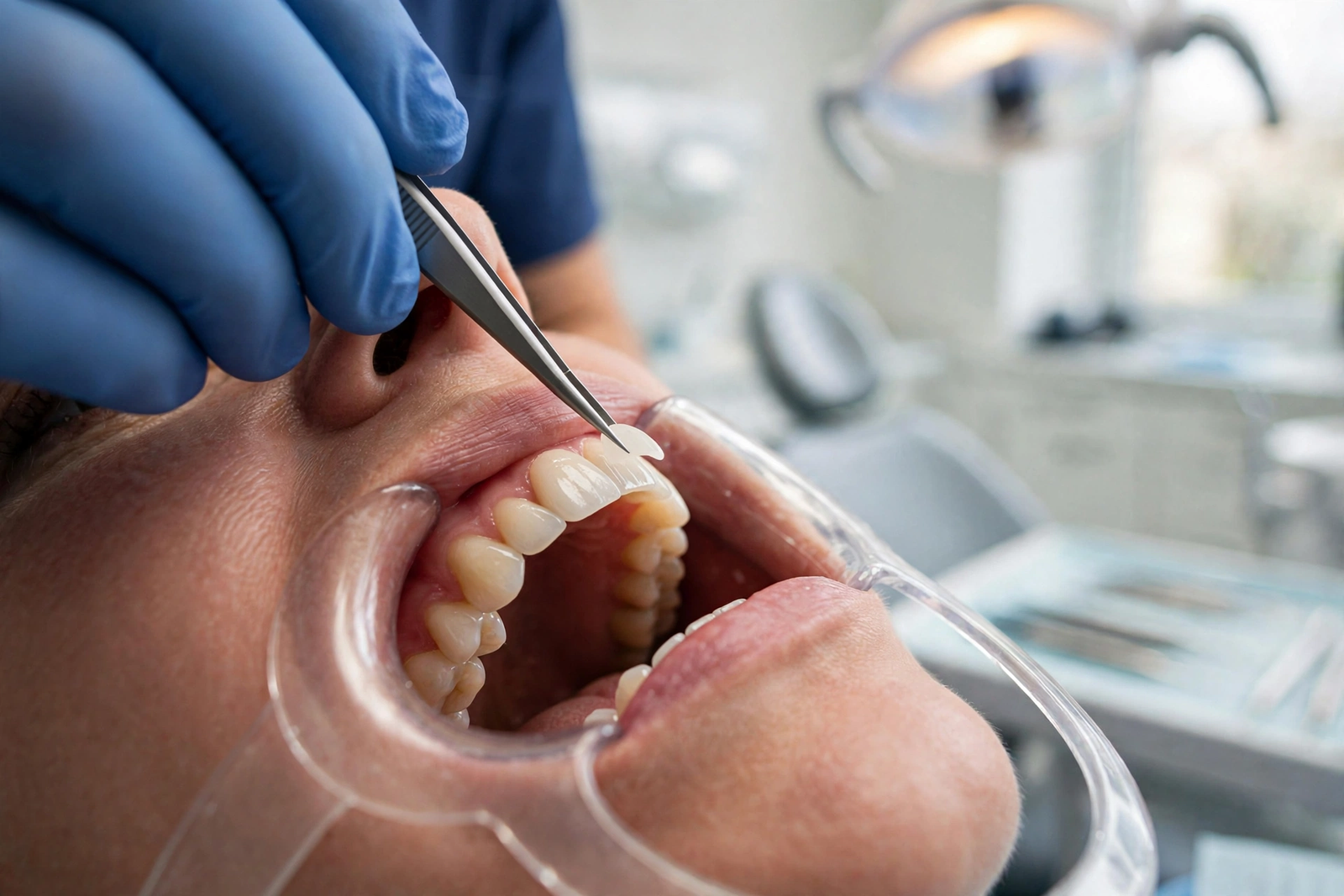
Veneers are priced per tooth but bought by the case. A veneer is a thin shell bonded to the front of a tooth to fix chips, gaps, staining or uneven shape. Practices publish prices in two materials, and the material is the biggest driver of the per-tooth number.
- Porcelain (ceramic) veneers: roughly $800 to $2,500 per tooth. Toronto practices published $800 to $1,200 in early 2026; a Toronto cosmetic practice published $1,500 to $2,000 for minimal preparation cases. National comparisons put the Canada-wide band at about $484 to $2,500.
- Composite (resin) veneers: roughly $300 to $1,000 per tooth in Ontario, with BC pages going as low as $250. One national comparison put composite at $226 to $1,087 across the country.
Treat low-end figures with caution: $484 is almost certainly the professional fee before the laboratory charge, not what you pay. Check the date on any price you read.
Porcelain vs Composite Veneers: Cost and Trade-Offs
Porcelain and composite veneers are different products doing an overlapping job, and the price gap reflects real differences.
| Feature | Porcelain veneer | Composite veneer |
|---|---|---|
| Price per tooth in Canada | $800 to $2,500 | $300 to $1,000 |
| Made | In a commercial dental lab | On the tooth, chairside |
| Appointments | Two or more, with lab time | Often one |
| Lab charge | Yes, billed separately | None |
| Staining | Resists stain well | Picks up stain, like a white filling |
| Repair | A chip means remaking the veneer | Often repairable chairside |
| Reversibility | Not reversible once enamel is removed | Depends on enamel prepared |
Composite costs less because it needs no lab work and takes one visit; the trade-off is durability and stain resistance. Porcelain costs more because a technician crafts each shell. The choice is clinical, not just budgetary: composite cannot mask very dark teeth the way porcelain can.
How Much Is a Full Set of Veneers?
Almost nobody gets one veneer. A cosmetic case usually treats everything that shows when you smile, most often the upper six to eight front teeth. Multiply the per-tooth range by the teeth count to see the real order of magnitude.
| Teeth | Porcelain at $800 | Porcelain at $1,500 | Porcelain at $2,500 |
|---|---|---|---|
| 2 | $1,600 | $3,000 | $5,000 |
| 4 | $3,200 | $6,000 | $10,000 |
| 6 (typical case) | $4,800 | $9,000 | $15,000 |
| 8 | $6,400 | $12,000 | $20,000 |
| 10 | $8,000 | $15,000 | $25,000 |
These are straight multiplications of published ranges, not quotes, and many practices discount larger cases. One London, Ontario practice published $7,200 to $25,000 for a full porcelain case and $2,000 to $15,000 for composite. Matching two new veneers to six natural teeth is also harder than a full arch.
Veneer Prices Across Canada
Dental fees are set by each practice, so prices vary by region. These are 2026 published bands, per tooth.
| Region | Porcelain | Composite |
|---|---|---|
| Vancouver, BC | $1,100 to $2,000 | $400 to $1,500 |
| Rest of British Columbia | $900 to $1,800 | $350 to $1,200 |
| Alberta | $900 to $1,900 | $350 to $1,300 |
| Ontario | $1,000 to $2,000 | $400 to $1,400 |
| Quebec | $800 to $1,800 | $300 to $1,200 |
| Other provinces and territories | $800 to $1,700 | $300 to $1,100 |
Toronto and Vancouver sit at the top; Quebec and smaller provinces trend lower. But the practice and its lab matter more: two quotes for the same six veneers can differ by thousands of dollars a few kilometres apart.
What Drives the Cost Up or Down
These factors move your total:
- Number of teeth. The biggest lever; every extra tooth multiplies the per-tooth fee.
- Preparation. Heavy preparation or bite problems add clinical time.
- Preparatory treatment. Decay and gum disease must be treated first, billed separately.
- The laboratory. A premium lab charges more, and the charge passes straight through to you. This is the biggest reason two quotes look nothing alike.
- Minimal preparation veneers. Ultra thin veneers carry premium fees and narrow candidacy.
- Extras. Temporary veneers, night guards and follow-ups; ask whether they are included.
Ask for each item in writing before you commit.
Reading a Quote: Professional Fee vs Laboratory Charge
This explains why one Canadian page says $484 and another says $2,500 for the same veneer: they are quoting different things.
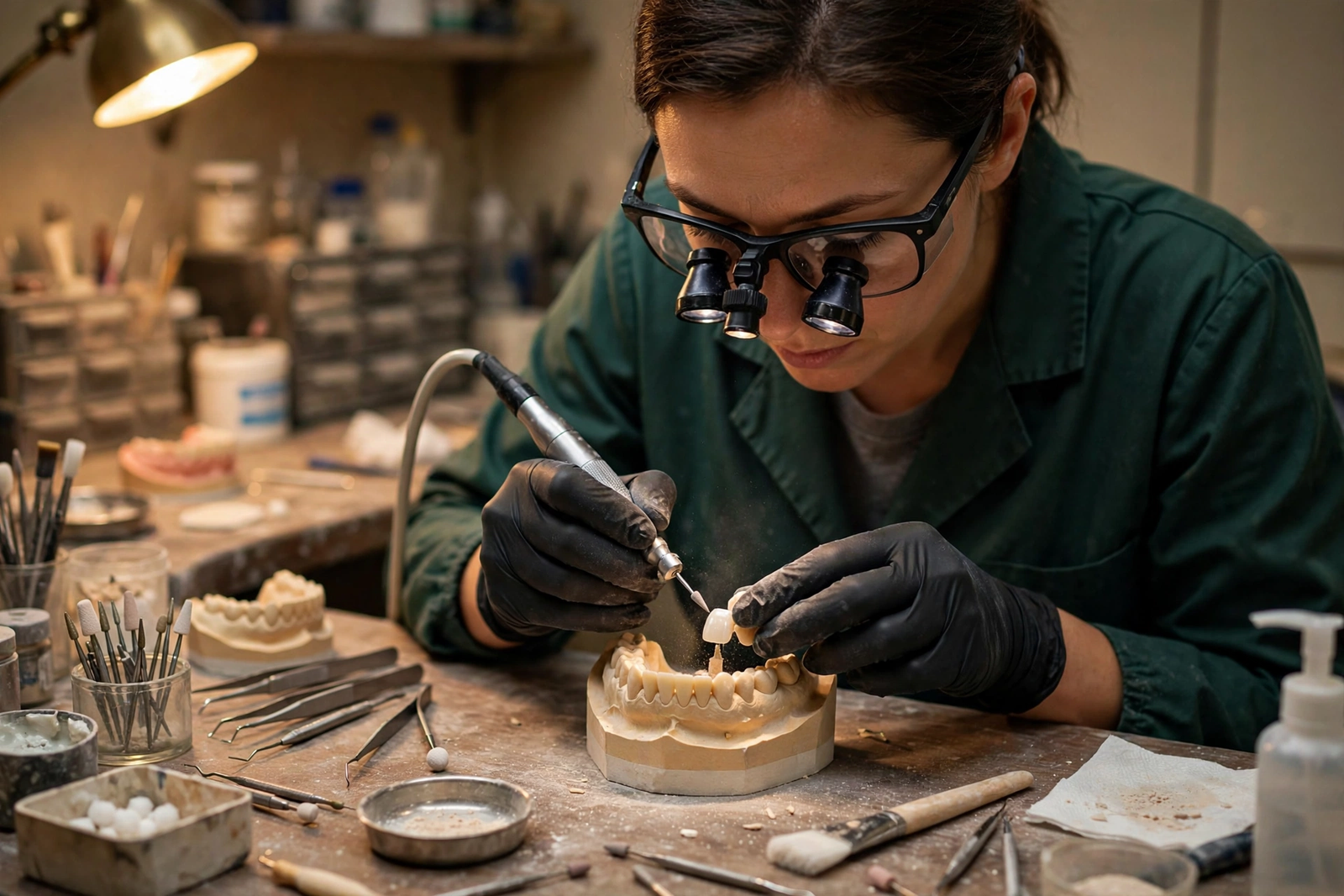
When a restoration is made outside the office, the practice pays a commercial laboratory to make it, then passes that charge on to you. The Ontario Dental Association states that laboratory fees are extra costs on top of the dentist's fee, and the charge passed to you is the exact amount the lab billed your dentist. Composite veneers have no laboratory stage at all, which is a large part of why they cost less.
A per-tooth number might be the professional fee only, the fee plus the laboratory charge, an advertised starting price, or a full case total. Almost nobody labels which one. Request an estimate covering both parts and ask for the laboratory portion in writing.
Insurance, CDCP and Paying for Veneers
Veneers are cosmetic, and Canadian coverage rules treat cosmetic dentistry harshly.
- Private dental insurance. Most plans classify veneers as elective and pay nothing. The rare exception is partial reimbursement for veneers repairing trauma damage. See our guide to dental insurance in Canada.
- CDCP. The Canadian Dental Care Plan lists veneers in composite or ceramic as a permanent exclusion, and permanent exclusions cannot be reconsidered. See our CDCP guide.
- Provincial plans. OHIP and other provincial medical plans do not cover office-based dental work at all.
Most patients pay out of pocket. Many practices offer payment plans or third party financing. If the estimate is unaffordable, ask about fewer teeth or composite, or alignment alternatives like braces or Invisalign. Implants are a separate expense: see dental implant cost in Canada.
Veneers in Mexico and Abroad
Many Canadians search veneers cost in Mexico because the gap is large: about $250 to $450 USD per tooth for porcelain in Mexico versus $740 to $1,628 USD in Canada. Eight to ten teeth advertised abroad for under $5,000 can cost around $20,000 at home, a 60 to 80 percent saving before travel.
The risks are real too: follow-up care far from the treating dentist, who has no obligation to fix another practice's work. If you go, verify credentials independently, get a written plan and warranty, and budget for a return visit.
Lifespan, Replacement and Long-Term Value
A veneer is not a one time purchase. Enamel removed for a veneer does not grow back, so the tooth will need a veneer or crown from then on. Porcelain typically lasts 10 to 20 years with proper care; composite lasts less and needs more touch-ups.
Replacement is a lifetime cost at the practice's current fee, so ask what a single replacement costs later. A night guard is advised for grinders; chewing ice and skipping cleanings shorten veneer life, and replacements are yours to pay.
Frequently Asked Questions
How much do veneers cost per tooth in Canada?
Porcelain veneers run roughly $800 to $2,500 per tooth and composite roughly $300 to $1,000, per 2026 published Canadian prices. Toronto and Vancouver sit at the top of the range; Quebec and smaller provinces trend lower.
What is the total cost for a full set of veneers?
Six to eight porcelain veneers total roughly $4,800 to $20,000. One Ontario practice published $7,200 to $25,000 for a full porcelain case and $2,000 to $15,000 for composite.
Are porcelain veneers worth the extra cost over composite?
Porcelain resists staining, looks more natural and lasts 10 to 20 years, but costs two to three times more and needs two visits plus a lab stage. Composite is cheaper and often done in one visit, but stains and lasts fewer years.
Does dental insurance cover veneers in Canada?
Usually not. Most plans classify veneers as elective cosmetic treatment and pay nothing. Some plans partially reimburse veneers that repair trauma damage. Ask for a predetermination in writing before treatment.
Does the CDCP cover veneers?
No. The Canadian Dental Care Plan lists veneers in composite or ceramic as a permanent exclusion, and permanent exclusions cannot be reconsidered. The plan covers essential care such as exams, fillings, crowns and root canals.
Why do veneer prices vary so much between clinics?
Prices often measure different things: some exclude the laboratory charge, others include it. Material, teeth count, preparation, lab quality and the city also move the number. Ask for an itemized estimate with the lab portion separated.
Can I get veneers cheaper in Mexico?
Yes. Porcelain runs about $250 to $450 USD per tooth in Mexico versus roughly $740 to $1,628 USD in Canada. Add flights, hotels and a return visit, and weigh the risks: follow-up far from the treating dentist.
How long do veneers last, and what does replacement cost?
Porcelain typically lasts 10 to 20 years with proper care; composite lasts less. Enamel removal is irreversible, so replacement is billed at the practice's current fee. A night guard helps grinders.
Do I have to pay for veneers all at once?
Most patients pay out of pocket. Many practices offer payment plans or third party financing. Compare the total with interest, and ask whether a smaller case or composite would meet your goal for less.
Sources
- Veneers Cost in Toronto and Ontario: 2026 Price per Tooth, Marketplace Dentistry
- Veneers Cost in Vancouver BC: 2026 Guide, Hemlock Dental Clinic
- Veneers Cost in Canada 2026: Complete Price Guide, CliniquePlus
- How Much Do Veneers Cost in 2026?, CureMeAbroad
- Canadian Dental Care Plan, Government of Canada
Related Guides
- Dental Costs in Canada
- Dental Insurance in Canada
- Invisalign Cost in Canada
- Dental Implant Cost in Canada
- Braces Cost in Canada
- CDCP: Canadian Dental Care Plan Guide