Canada’s Dental Staff Shortage: 7,200 Vacancies and What It Means for Clinic Owners
Dek: Dentists say the Canadian Dental Care Plan has brought millions of new patients through the door, but there are not enough hygienists and assistants to treat them.
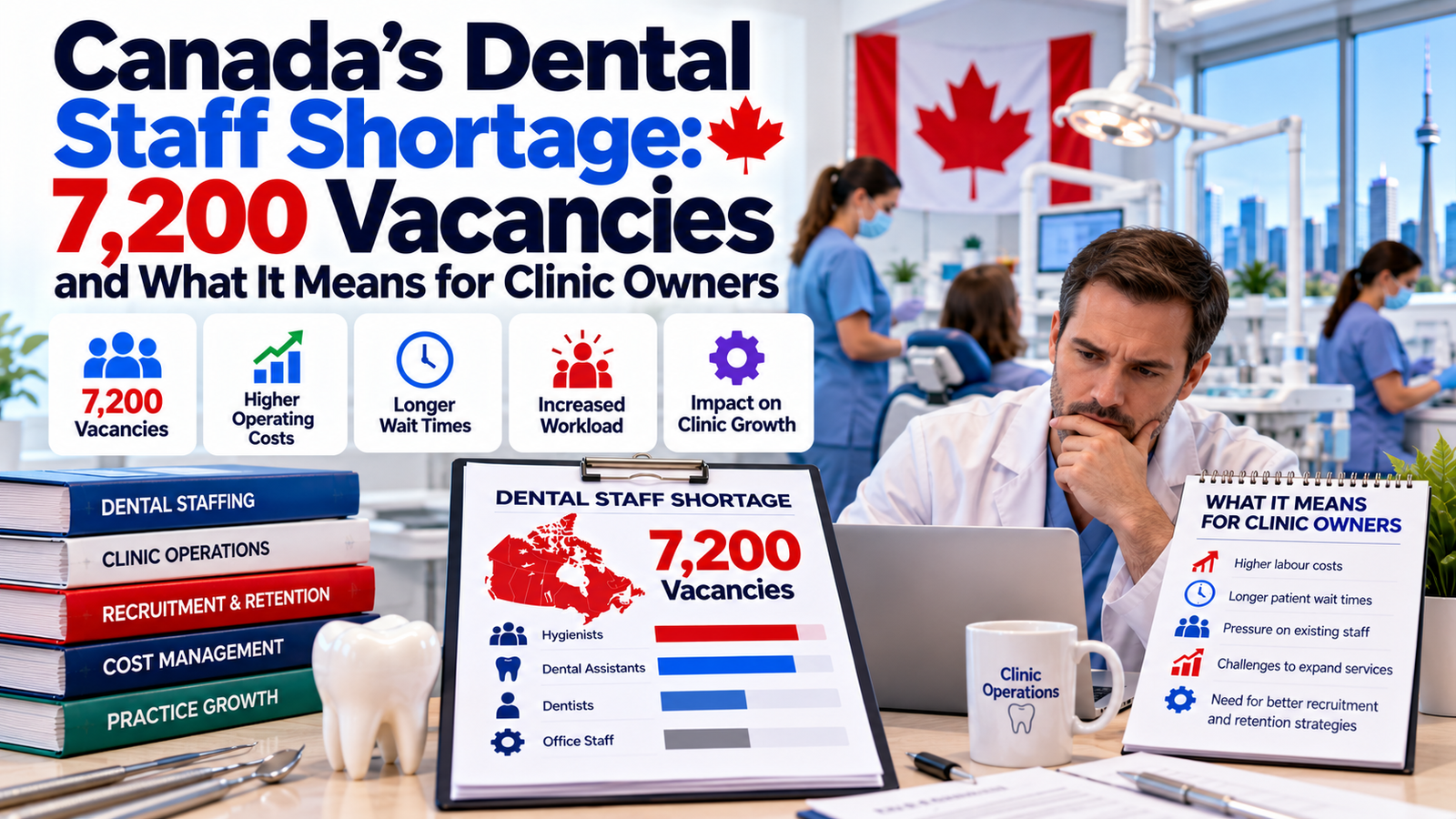
Canadian dentistry is short roughly 7,200 hygienists and dental assistants, according to a figure cited by the Canadian Dental Association (CDA), and the gap is widening as the Canadian Dental Care Plan sends millions of new patients to clinics. The shortage is most severe outside major cities. For clinic owners, it is now a limit on how many patients a practice can treat, as well as a hiring problem.
Key facts
- Vacancies: about 7,200 for dental hygienists and dental assistants across Canada, a figure cited by CDA president Dr. Kirk Preston.
- Where it bites hardest: regions outside major urban centres, Preston said.
- Federal outlook: the Canadian Occupational Projection System identifies a strong risk of labour shortage for dental hygienists and dental therapists from 2024 to 2033.
- Demand: 3.9 million people received care under the CDCP in 2025-26.
- Local example: in Nova Scotia, a provincial association’s job bank listed 138 openings for hygienists and assistants in early October 2026.
What happened
Two reports in the first week of October put the shortage back in focus. On October 3, Oral Health Group reported, citing the Chronicle Herald, that Nova Scotia continues to face shortages of dental hygienists, dental assistants and administrative staff despite a spring recruitment fair. The province’s association job bank listed 138 postings for hygienists and assistants, along with about two dozen administrative roles, on the day the paper checked. Oral Health Group had earlier attributed the shortage to an aging workforce and to people leaving the profession after the pandemic. The Canadian Dental Hygienists Association is calling for better workplace conditions.
Three days later, the CDA released its assessment of the Canadian Dental Care Plan. CTV News reported that the report notes lingering administrative burdens and about 7,200 vacancies for hygienists and assistants. In the report’s foreword, Preston wrote that coverage only helps patients when a dental team is available to provide the care. He also said in the report that shortages put real pressure on care delivery in regions like New Brunswick, where he practises, and that when a practice cannot staff a chair, the patient waits.
How the CDCP changed the equation
The shortage is not new. Ottawa dentist Dr. Isha Moza told CTV News that there was a workforce problem in the field even before the CDCP. What changed is the demand. The program began paying claims for seniors in May 2024 and opened to all eligible ages a year later. In 2025-26, 6.5 million people were enrolled and 3.9 million received care, according to federal data reported by CTV.
Moza said the influx of new patients is welcome, since many have never been to a dentist before. But the combination of millions of new patients and the plan’s added administrative load, she said, makes the staff shortage feel worse. The administrative side matters because the staff who prepare preauthorizations, verify coverage and chase claims are often the same people who are scarce. Our guides to CDCP preauthorization and CDCP claims describe the paperwork involved.
The federal projection system adds a longer view. It flags a strong risk of shortage for dental hygienists and dental therapists through 2033. Oral Health Group notes that population growth and expanded access through the CDCP are both expected to raise demand for dental services.
The picture outside Canada
Canada is not alone. In the United States, the American Dental Hygienists’ Association updated its workforce position statement in May 2026 and described the situation as a documented retention crisis, calling for action at the practice level. The comparison is a reminder that the problem is not only about training new hygienists. It is also about keeping the ones already working.
Why it matters to clinic owners
This section is analysis, based on the reporting above.
Capacity. A practice can have all the equipment and demand it needs, but an empty hygiene chair produces no revenue and creates a backlog of recalls. If CDCP patients are waiting longer for appointments, the limit is probably labour.
Cost. Scarce staff command higher pay and more flexibility. Owners who underpay or run rigid schedules lose people to clinics that do not.
Quality of care. Dentists doing more of the work that team members would normally handle have less time for complex treatment, and burnout becomes a risk.
Practice value. Buyers and lenders look at team stability when assessing a practice. Our guide to valuing a dental practice lists staffing among the factors that affect price.
Growth. Marketing for new patients makes less sense when the clinic has no spare hygiene capacity. Local search investment works best when the practice can serve the people it brings in.
What clinics can do now
None of these steps will end a national shortage. They can improve the odds in a single practice.
- Treat retention as a strategy. Ask team members what would make them stay, and act on the answers. Pay, predictable schedules, professional development and a respectful workplace are the usual themes.
- Use every channel to recruit. Provincial dental association job banks, hygiene and assisting program placements, and regulatory college job boards are all worth using. Early relationships with students pay off.
- Reduce the administrative load on clinical staff. Assign preauthorization and claims work to a trained coordinator, and standardize documentation so that submissions are right the first time.
- Make the schedule do more. Review recall intervals, appointment lengths and the mix of procedures. A small improvement in hygiene scheduling can recover several appointments a week.
- Cross-train. Staff who can cover reception, sterilization and chairside work make a small team more resilient.
- Be honest with patients about wait times. Clear communication costs little and prevents complaints, especially from CDCP patients who may be new to dental care.
- Track the data. Count vacant shifts, overtime and appointments lost to staffing so you can act on evidence.
What the CDA wants from governments
The association’s wider recommendations call for the federal government to develop an overall oral health strategy that includes initiatives to strengthen the dental workforce, such as protecting dental student training, and improve oral health data. Workforce measures sit alongside requests to ease preauthorization and administrative barriers, which would also free up staff time.
The federal health minister said she would work with the CDA on its recommendations but did not announce workforce measures. Education and licensing are largely provincial responsibilities, so any national strategy would need provincial cooperation.
What to watch
- Federal response. Whether Health Canada or the Minister announces measures on workforce data, student training or administrative simplification.
- Provincial action. Changes to scopes of practice, licensing or recruitment programs from provincial governments and regulators.
- Enrolment trends. The CDCP’s 2026-27 enrolment stood at 4.7 million so far, and any further growth in patients will add to pressure on capacity.
- Local indicators. Job bank listings, program waitlists and recall backlogs in your region.
Sources
Oral Health Group, October 3, 2026; CTV News, October 6, 2026; American Dental Hygienists’ Association newsroom. Figures are as reported in early October 2026 and may change.