
Key Facts
| Fact | Detail |
|---|---|
| What it covers | Every name and number used for your 32 permanent teeth, plus the 20 primary teeth in children. |
| The three systems | Universal (ADA), FDI two-digit notation, and Palmer notation. Canada uses the FDI system most often. |
| FDI basics | First digit is the quadrant (1 to 4 for adult teeth), second digit is the tooth position from the front (1 to 8). |
| Universal basics | Numbers 1 to 32 around the whole mouth, starting at the upper right wisdom tooth. Common in the United States. |
| Palmer basics | Numbers 1 to 8 per quadrant with a symbol showing the quadrant. Common in orthodontics. |
| Tooth names | Incisors, canines, premolars and molars, including wisdom teeth at the back of each quadrant. |
If your dentist has ever said you need a filling on tooth 46 or an extraction on tooth 18, you have probably wondered what those numbers mean. Teeth names and numbers are the shorthand that dental professionals use to identify every tooth quickly and without confusion, and this guide explains all three numbering systems used around the world, plus the plain names behind them.
Most online charts show you a picture and stop there. Here you will learn how each system works, which one Canadian dentists actually use, and what each type of tooth does, so a phrase like lower left first molar makes complete sense.
In This Guide
- Why Teeth Have Numbers
- The Three Numbering Systems
- Universal (ADA) Numbering System
- FDI Two-Digit Notation: The System Used in Canada
- Palmer Notation
- Comparing the Systems Side by Side
- Names of the Teeth: Incisors, Canines, Premolars, Molars
- Primary (Baby) Teeth Numbering
- Why Tooth Numbers Matter for Treatment
- How to Read Your Own Dental Chart
- Frequently Asked Questions
Why Teeth Have Numbers
Saying upper right first molar takes time and can be misunderstood, especially when two teeth could fit the description. A number like 16 removes all doubt. Tooth numbering gives every dental professional, from the dentist to the hygienist to the specialist reading your X-rays, the same exact language for the same tooth.
Numbering matters most in three situations. First, record keeping: your chart must show exactly which tooth had treatment, especially if you change clinics. Second, referrals: a specialist receiving your case must know precisely which tooth the problem is on. Third, insurance claims: benefit plans such as the CDCP and private insurers need the exact tooth number to process a claim.
Three systems grew up in different countries to solve this problem, and they are still all in use today. The Dental Reference Hub puts this guide in context alongside our other reference articles, but each numbering system below is explained fully on its own.
The Three Numbering Systems
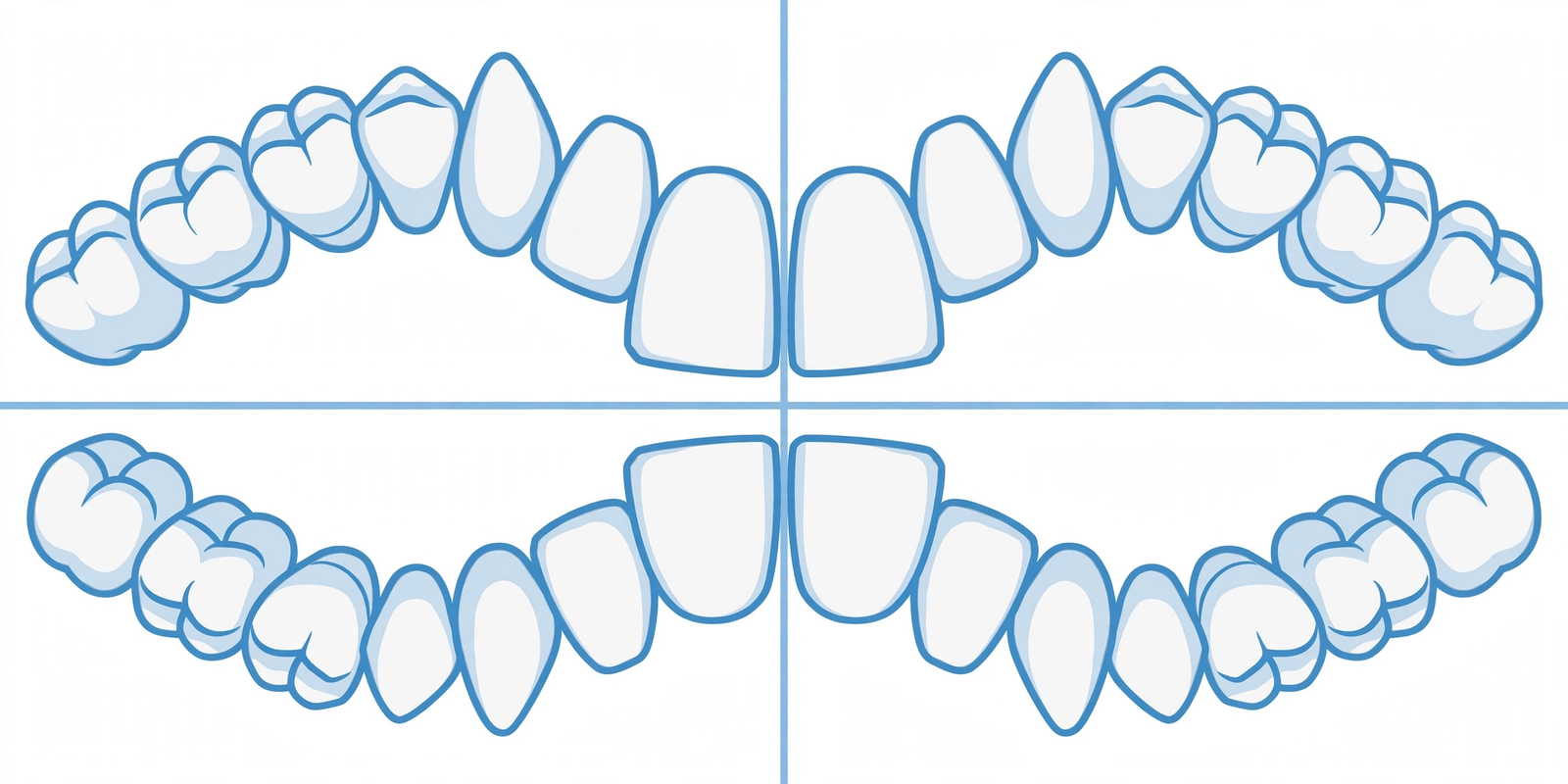
There are three main tooth numbering systems used worldwide:
- Universal (ADA) numbering: one number per tooth, 1 to 32 for adults. Used mainly in the United States.
- FDI two-digit notation: a two-digit code for every tooth. The international standard, used across Canada.
- Palmer notation: numbers 1 to 8 within each quadrant, with a symbol for the quadrant. Popular with orthodontists.
Each system describes the same 32 teeth. They are simply different maps of the same mouth. Learning how each one works makes it easy to understand any dental chart you see.
Universal (ADA) Numbering System
The Universal system was adopted by the American Dental Association in 1968. It assigns a single number to each permanent tooth, running 1 to 32 in a clockwise loop around the mouth.
Numbering starts at the upper right third molar (tooth 1), travels forward along the top teeth to the upper left third molar (tooth 16), drops to the lower left third molar (tooth 17), and travels forward and around to the lower right third molar (tooth 32).
Children's teeth use letters instead of numbers in this system: A to T for the 20 primary teeth, starting at the upper right second molar and following the same clockwise loop.
Because the Universal system is the standard in the United States, you will see it on most American dental websites and products. If you read a treatment plan from a US dentist, expect numbers like 3 for the upper right canine or 30 for the lower right first molar.
FDI Two-Digit Notation: The System Used in Canada
The FDI system, also called ISO 3950 notation, is the most commonly used dental labelling system in Canada. Each tooth gets a two-digit code. The first digit is the quadrant, the second digit is the tooth position counting from the centre of the mouth outward.
The quadrant digits for permanent teeth are:
- 1: upper right
- 2: upper left
- 3: lower left
- 4: lower right
For primary (baby) teeth the quadrants are numbered 5 to 8, with 5 upper right, 6 upper left, 7 lower left and 8 lower right.
The second digit runs 1 to 8 from the central incisor (1) to the wisdom tooth (8). So tooth 11 is the upper right central incisor, tooth 26 is the upper left first molar, and tooth 46 is the lower right first molar. The two digits are read as one, eight rather than eighteen, so code 18 unambiguously means the upper right wisdom tooth.
Canada adopted the FDI system for teaching and clinical records, and most provincial fee guides use it. If your Canadian dental bill lists two-digit tooth numbers, this is the system being used. Our tooth charts page shows the full FDI grid as a visual diagram if you want to see every code at a glance.
Palmer Notation
Palmer notation is the oldest of the three systems, developed by Adolf Zsigmondy in 1861 and named for Corydon Palmer. It numbers the teeth 1 to 8 within each quadrant, counting from the central incisor (1) to the third molar (8), and adds a symbol to show which quadrant the tooth is in.
The quadrant symbols are shaped like a corner bracket: ┘ for upper right, └ for upper left, ┌ for lower left, and ┐ for lower right. So 5┘ means the upper right second premolar, and 3┌ means the lower left canine. For primary teeth, the digits become the letters A to E with the same symbols.
Palmer notation is still common among orthodontists and in the United Kingdom, because it is quick to write by hand and the symbols are instantly recognisable on a printed chart. Its main drawback is that the symbols cannot be typed easily, which is why the FDI system took over in most digital dental records.
Comparing the Systems Side by Side
The same teeth in all three systems, quadrant by quadrant (permanent teeth):
| Tooth | Universal | FDI | Palmer (UR quadrant) |
|---|---|---|---|
| Upper right central incisor | 8 | 11 | 1┘ |
| Upper right first premolar | 5 | 14 | 4┘ |
| Upper right first molar | 3 | 16 | 6┘ |
| Upper right wisdom tooth | 1 | 18 | 8┘ |
| Upper left central incisor | 9 | 21 | 1└ |
| Upper left first molar | 14 | 26 | 6└ |
| Lower left central incisor | 24 | 31 | 1┌ |
| Lower right first molar | 30 | 46 | 6┐ |
| Lower right wisdom tooth | 32 | 48 | 8┐ |
Notice the trap for newcomers: tooth 18 in FDI is an upper right wisdom tooth, while tooth 18 in Universal is a lower left second molar. This is exactly why knowing which system is in use matters before you interpret any dental number.
Names of the Teeth: Incisors, Canines, Premolars, Molars
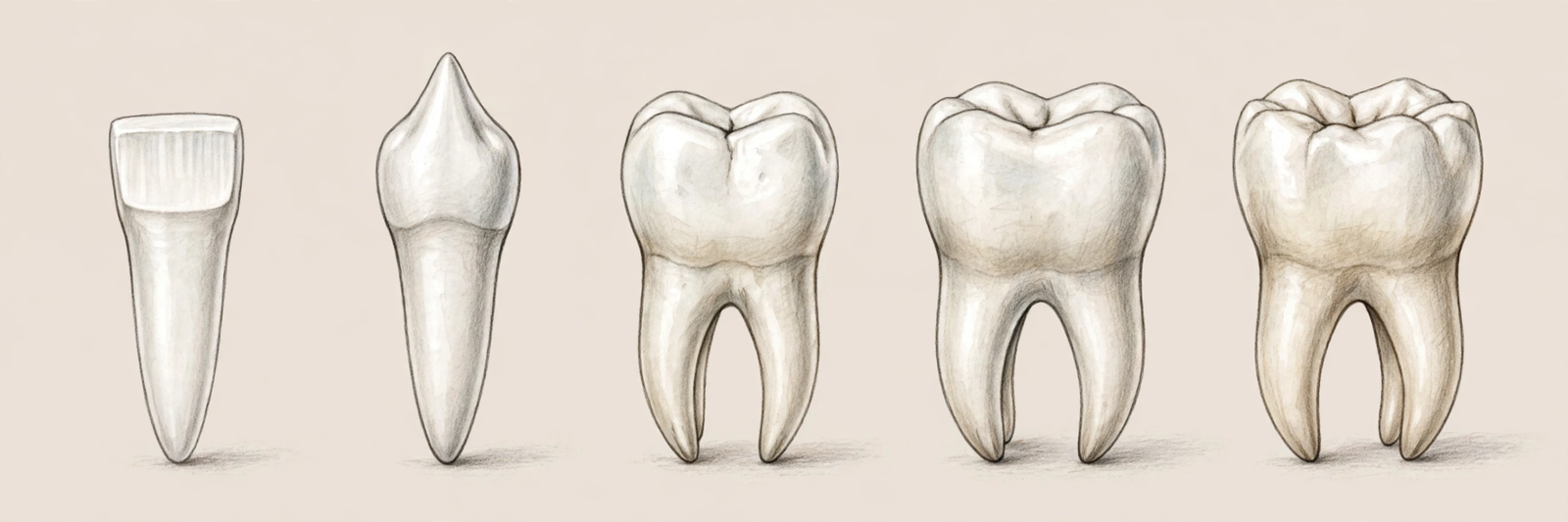
Behind every number is a plain English name. Each adult quadrant holds eight teeth in five types:
- Central incisors (2 per quadrant group): the four front teeth, two up and two down. Their flat, sharp edges cut food like scissors.
- Lateral incisors: the teeth beside the centrals, slightly smaller, helping to cut and guide the front teeth during biting.
- Canines (cuspid teeth): the pointed teeth, sometimes called eye teeth. They tear food and guide the bite so the back teeth do not grind sideways against each other.
- First and second premolars (bicuspids): the first adult-only teeth after the canines. With two small points (cusps), they crush and tear food. Children do not have premolars; their baby molars hold the space until these arrive.
- First and second molars: the large, broad chewing teeth with four or five cusps each, doing the heavy grinding work.
- Third molars (wisdom teeth): the last teeth to arrive, usually between ages 17 and 25, at the very back of each quadrant. Many adults never get all four.
In total, an adult mouth has 8 incisors, 4 canines, 8 premolars and 12 molars, which is 32 teeth. That full count is rare in practice, since wisdom teeth are often removed and teeth can be lost to decay, gum disease or injury.
Primary (Baby) Teeth Numbering
Children have 20 primary teeth: 10 on top and 10 on the bottom, with no premolars. In the Universal system they are lettered A to T clockwise from the upper right second molar. In the FDI system they use quadrant digits 5 to 8, so 55 is the upper right second baby molar and 81 is the lower right central baby incisor. In Palmer notation they are lettered A to E per quadrant with the same quadrant symbols as adult teeth.
Baby teeth usually start arriving around six months of age and are all in place by about age three. They begin falling out around age six, making way for the permanent teeth, which are fully in place (except wisdom teeth) by the early teens.
Why Tooth Numbers Matter for Treatment
Tooth numbers are not just paperwork. They directly affect your treatment and your wallet. When a dentist recommends a crown on tooth 36 (FDI: lower left first molar), the exact number goes onto the treatment plan, the lab prescription for the crown, and the insurance or CDCP claim. A wrong number can mean treatment on the wrong tooth or a rejected claim.
This is most visible with extractions and wisdom teeth. A plan to remove all four wisdom teeth is recorded as 18, 28, 38 and 48 in FDI notation. If you want to understand what your own extraction plan covers, see our guide to tooth extraction. Knowing the numbers also helps you ask better questions, because you can point to the exact tooth instead of saying the one at the back.
How to Read Your Own Dental Chart
Most Canadian dental charts use the FDI system. To read one, start by finding the legend: it should say FDI or show two-digit codes. Then read the first digit to find the quadrant and the second digit to find the position from the front.
For example, code 25 is quadrant 2 (upper left), position 5 (second premolar), so it is the upper left second premolar. Code 33 is quadrant 3 (lower left), position 3 (canine), the lower left canine.
Symbols on the chart add more detail: shading or red marks usually mean decay or damage, an X or circle can mean a missing tooth, and letters may indicate crowns or fillings. If anything on your chart confuses you, ask your dentist to walk through it. It takes about two minutes and most dentists are happy to explain. For the full picture of what a chart shows, our dental anatomy guide explains the parts of a tooth that charts record.
Frequently Asked Questions
What are the names of the teeth?
Adults have five tooth types: incisors, canines, premolars, molars and wisdom teeth (third molars). There are 8 incisors, 4 canines, 8 premolars and 12 molars, totalling 32 teeth.
Which tooth numbering system is used in Canada?
Canadian dentists use the FDI two-digit system: the first digit is the quadrant (1 to 4 for adult teeth) and the second digit is the tooth position from the front (1 to 8).
What does tooth 46 mean?
In the FDI system, 46 is the lower right first molar: quadrant 4 is lower right and position 6 is the first molar. It is one of the most commonly filled and crowned teeth.
What is tooth 18?
In the FDI system, tooth 18 is the upper right wisdom tooth (third molar). Be careful: in the US Universal system, tooth 18 is a completely different tooth, the lower left second molar.
Why are teeth numbered instead of named?
Numbers remove ambiguity. A number like 26 always means the exact same tooth to every dentist, hygienist, specialist and insurer, while names can be misheard or misunderstood.
How many teeth do adults have?
Adults have 32 permanent teeth, including four wisdom teeth. Many people have fewer because wisdom teeth are commonly removed or never develop.
What is the Universal numbering system?
The Universal system, adopted by the American Dental Association in 1968, numbers adult teeth 1 to 32 in a clockwise loop starting at the upper right wisdom tooth. It is the standard in the United States.
What is Palmer notation?
Palmer notation numbers the teeth 1 to 8 within each quadrant and adds a symbol (┘ └ ┌ ┐) to show the quadrant. It is popular with orthodontists and in the UK, but hard to type on keyboards.
Do baby teeth have numbers too?
Yes. In the FDI system, baby teeth use quadrants 5 to 8 (for example, 55 is the upper right second baby molar). In the Universal system they are lettered A to T.
How can I find my tooth number?
Look at your dental chart or treatment plan from your dentist. Canadian charts almost always use FDI two-digit codes: read the first digit as the quadrant and the second digit as the position from the front.
Sources
- Tooth Structure and Identification, eCampusOntario (Conestoga College)
- Tooth Numbering: FDI, Universal and Palmer Compared, MOS Dental Hospital
- FDI Tooth Numbering System, Canadian Academy of Dental Health
- What Tooth Numbering System Is Used in Canada
Related Guides
- Dental Reference Hub
- Tooth Charts
- Dental Anatomy Guide
- Tooth Extraction Guide
- Dental Costs in Canada